
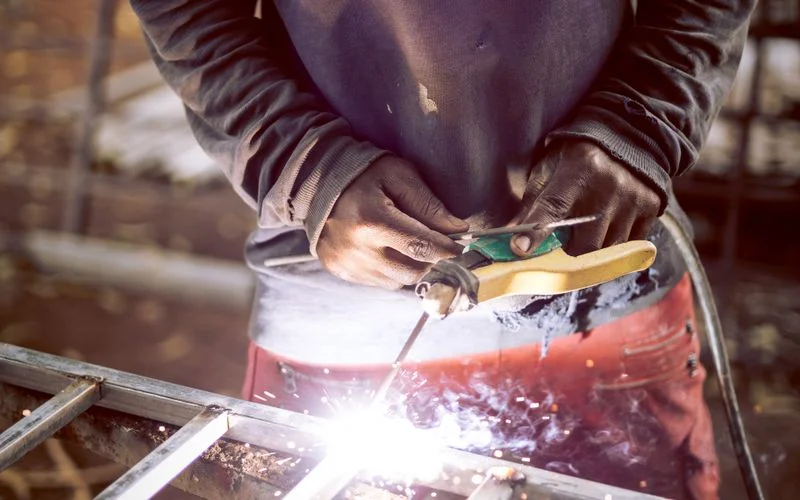
All three processes — MIG, TIG, and stick — create a fusion weld by melting metal and adding filler material. The difference is how the arc is created, how filler is delivered, and what that means for speed, appearance, and the materials that can be welded. For a customer, the practical question is: which process produces the best result for my job, and does the welder I'm hiring have the right equipment?
Quick Reference: Process by Application
| Process | Best for | Not ideal for | Speed | Appearance |
|---|---|---|---|---|
| MIG (GMAW) | Steel, mild steel, thicker sections, fabrication | Thin material, stainless (usually), aluminium (often) | Fast | Good, requires cleanup |
| TIG (GTAW) | Stainless, aluminium, thin gauge, visible welds | Thick structural steel, outdoor/windy conditions | Slow | Excellent |
| Stick (SMAW) | Structural steel, site work, rusty/painted metal | Thin material, stainless, aluminium, cosmetic welds | Medium | Rough, requires grinding |
MIG Welding (GMAW) — The Site Workhorse
MIG (Metal Inert Gas) or GMAW (Gas Metal Arc Welding) uses a continuously fed wire electrode that melts into the weld pool, shielded by a flow of inert or semi-inert gas (usually a CO₂/argon mix for steel).
Why it's the default for most jobs: MIG is fast, produces strong welds, and is easy to use in most positions. For mild steel fabrication and repair — gate frames, trailers, structural connections, brackets, ute trays — MIG is almost always the right process. The setup is relatively quick, and deposition rates are high.
Limitations: MIG is sensitive to wind and draught on outdoor sites — the gas shield gets blown away, causing porosity. It's not ideal for thin material under about 1.5mm. For stainless steel, MIG is technically possible (with stainless wire and pure argon or tri-mix gas) but TIG is preferred for most applications because MIG stainless is harder to control and produces more spatter and distortion.
Mobile context: We use MIG for the majority of steel welding jobs. It's the process behind gate repairs, fence repairs, structural tacks, trailer repairs, and most steel fabrication work. Our rate for steel welding is $110/hr regardless of whether the specific weld is MIG or stick — the job scope drives the rate, not the electrode type.
TIG Welding (GTAW) — Precision and Appearance
TIG (Tungsten Inert Gas) or GTAW (Gas Tungsten Arc Welding) uses a non-consumable tungsten electrode to create the arc, with filler rod fed separately by the welder's free hand. The weld pool is shielded by pure argon or helium.
Why it's the standard for stainless and aluminium: TIG gives the welder precise control over heat input and filler addition. This matters enormously for stainless steel (which sensitises with excess heat) and aluminium (which burns through with too much input on thin sections). The result is a clean, narrow bead with minimal distortion and a finish that can be polished or left as-welded on visible surfaces.
Limitations: TIG is significantly slower than MIG. A 500mm TIG weld on 3mm stainless takes considerably longer than the same length in MIG on steel. It requires both hands — torch in one, filler rod in the other — which makes some positions more difficult. It's also very sensitive to contamination; the slightest grease or oxide on the workpiece causes weld defects.
Mobile context: TIG is our process for all stainless steel and aluminium work — pool fencing, handrails, balustrades, marine hardware, and architectural metalwork. Our stainless rate is $150/hr and aluminium is $180/hr, reflecting the skill level and slower deposition rate. For more on stainless TIG specifically, see our stainless steel TIG welding guide.
Stick Welding (SMAW) — The Outdoor and Structural Process
Stick or SMAW (Shielded Metal Arc Welding) uses a consumable electrode coated in flux. As the electrode melts, the flux coating produces a gas shield and a slag layer that protects the weld pool — no external shielding gas required.
Why it's valued for site and structural work: Because stick doesn't rely on a gas shield, it works outdoors in wind where MIG would fail. It also works better on lightly rusted or painted steel than MIG (the flux is more forgiving). For structural steel welding, prequalified stick electrodes (E4818, E4816) are commonly used because they're well-documented, widely understood, and covered under AS/NZS 1554.
Limitations: Stick is slower than MIG, produces significant spatter and slag that requires cleaning, and leaves a rougher bead appearance. It's not suitable for thin material (below about 3mm). For stainless steel, specialist electrodes exist but TIG is almost always preferred.
Mobile context: We use stick for outdoor structural work and for sites where running shielding gas is impractical. For a builder wanting structural tacks on a windy construction site or repair welds on farm machinery, stick may be the right choice. The rate structure is the same as MIG for steel — it's the job type that drives cost.
Does the Process Affect What You Pay?
The process affects your cost indirectly through time and material type:
- MIG steel welding: Fastest deposition, lowest labour cost per metre of weld. Rate: $110/hr.
- Stick structural welding: Slightly slower than MIG but similar cost. Rate: $110/hr for steel.
- TIG stainless: 30–50% slower deposition than MIG, plus consumable and equipment cost. Rate: $150/hr.
- TIG aluminium: Slowest of the three — aluminium's conductivity requires careful heat management. Rate: $180/hr.
For most customers, the process question is answered by the material: steel means MIG or stick, stainless or aluminium means TIG. If a welder tells you they'll MIG weld your stainless pool fence, ask why — that's usually a warning sign.
See our material comparison guide for help choosing the right metal for your project, and our cost guide for a full breakdown of how pricing works across job types. Call 0426 829 762 or request a quote — we'll confirm the right process before arriving. Full mobile welding service details here.