
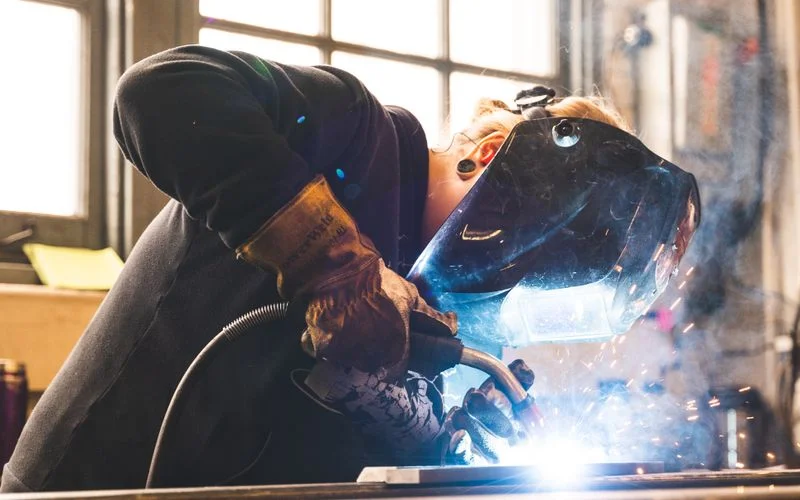
More Sydney welding jobs specify stainless steel than ever before — pool fencing, architectural balustrades, commercial kitchen equipment, marine hardware. The aesthetic appeal and corrosion resistance are the obvious reasons. What's less obvious is why stainless is harder to weld than mild steel, and why you need a welder who understands the material, not just someone who knows how to hold a torch.
Why Stainless Steel Needs TIG (Mostly)
TIG (Tungsten Inert Gas, or GTAW) is the preferred process for most stainless steel welding for three reasons:
Contamination sensitivity. Stainless derives its corrosion resistance from a thin chromium oxide layer on its surface. The slightest contamination — grease, carbon from a mild steel brush, grinding sparks from carbon steel nearby — can compromise that layer at the weld zone and create a corrosion point. TIG welding uses a non-consumable tungsten electrode and the welder feeds filler rod by hand, giving far more control over the weld pool and heat-affected zone than MIG.
Heat input control. Stainless has lower thermal conductivity than mild steel, meaning heat builds up faster and spreads less. High heat input causes sensitisation — chrome carbide precipitation at grain boundaries in the heat-affected zone, which makes the material susceptible to intergranular corrosion. TIG's precise heat control minimises this risk. For thin-gauge stainless (1.5mm–3mm, common in architectural work), MIG is difficult to control without burn-through; TIG handles it cleanly.
Appearance. For visible welds — handrails, balustrades, architectural screens — TIG produces a neater, more consistent bead than MIG. A brushed or polished stainless surface with a clean TIG weld looks professional. A MIG weld on stainless is functional but harder to dress to the same standard.
MIG welding stainless is suitable for thicker material (6mm+) where high deposition rate is more important than appearance, or for industrial/structural applications where aesthetics aren't critical. If a quote specifies MIG stainless on visible handrails or pool fencing, ask why.
Stainless Grades: 304 vs 316
Grade 304 (also called A2 or 18/8) is the standard workhorse stainless: 18% chromium, 8% nickel, good corrosion resistance for most environments. It's used in kitchen equipment, indoor architectural features, and sheltered outdoor applications inland.
Grade 316 (also called A4 or marine grade) adds 2–3% molybdenum. This significantly improves resistance to chloride attack — including salt air, pool chemicals, and coastal moisture. It's the specified grade for pool fencing and balustrading, marine hardware and boat fittings, anything within about 5km of the coast in Sydney, and commercial kitchen equipment that sees regular chemical cleaning.
The price difference is real: 316 tube and flat bar costs roughly 15–25% more than equivalent 304. The weldability is similar, but 316 is slightly more sensitive to heat input and requires equivalent grade 316L filler wire. Using 304 filler on 316 base material is a mistake that reduces corrosion performance at the weld — a point to verify with your welder.
For a fuller comparison of stainless, mild steel, and aluminium properties and costs, see our material comparison guide.
Common Applications in Sydney
- Pool fencing and pool area gates — Grade 316 is standard for pool compliance. Tubing posts, horizontal rails, gate hardware. See our pool fencing service.
- Architectural balustrades and handrails — 316 for outdoor, coastal properties; 304 for interior and sheltered applications. For more on handrail specifications and compliance, see our handrail welding guide.
- Commercial kitchen equipment — Benches, shelving, splash backs, rack systems. Usually 304 unless specified otherwise. Hygienic welds — flush, no crevices — are required.
- Marine hardware — Deck fittings, bow rails, stern rails, engine brackets. 316 only. Usually TIG to minimise heat distortion on thin sections.
- Architectural screens and facades — Decorative elements, louvres, entry features. Often laser-cut and TIG welded for tight tolerances and clean appearance.
- Exhaust systems — Food processing, chemical plants, and automotive. High-temperature stainless grades (321, 316Ti) are sometimes specified.
The Welding Process — What Good Stainless TIG Looks Like
Preparation. The work area must be completely clean and free of carbon steel contamination. Stainless steel grinding discs and wire brushes (never used on carbon steel) are mandatory. All surfaces are degreased with an appropriate solvent before welding.
Back purging. For structural and pressure-critical joints on tubes and pipes, the weld root is purged with argon or nitrogen to prevent oxidation on the back side of the weld. This produces a clean, oxide-free root bead (the "sugar" — blue/black oxidation on the back of the weld — is a sign back purging wasn't done or wasn't adequate).
Tungsten preparation. The tungsten electrode must be dedicated to stainless — cross-contamination with mild steel contaminates the weld. For 316 stainless, a ceriated or lanthanated tungsten with a sharp point is typical.
Post-weld treatment. After welding, the weld area is typically pickled (using a citric or phosphoric acid paste) to remove surface oxides and restore the passive layer, then passivated. For visible architectural welds, grinding and polishing back to the parent metal finish is also standard.
Stainless Welding Cost vs Mild Steel
Stainless welding costs more than mild steel for three reasons: slower process (TIG vs MIG takes longer per metre of weld), specialist consumables (TIG filler rod is more expensive than MIG wire, and pure argon shielding gas is used rather than the cheaper mixed gas used for steel), and the higher skill and care required.
Mobile Welders's rates: $150/hr for stainless, compared to $110/hr for mild steel. The call-out structure is the same ($350 + GST for the first hour).
For a typical pool fencing job (replacing a section of 316 stainless tube), expect 1.5–3 hours on-site depending on length and complexity. Gate hinges and latches, which require more precise fit-up, take longer per metre than straight section replacement.
Questions to Ask Your Mobile Stainless Welder
- "Is your TIG equipment and consumables dedicated to stainless?" (Cross-contamination is a real risk)
- "Do you carry 316 filler rod?" (Not just 304)
- "Will you back-purge the tube joints?" (For pool fencing and structural tubing)
- "What finish will the welds be when you're done?" (Pickled, polished, or as-welded)
- "Do you have photos of previous stainless TIG work?"
A welder who hesitates on contamination prevention or doesn't know the difference between 304 and 316 filler rod is not a stainless specialist.
Our stainless steel welding service covers Sydney metro, and all stainless work is TIG with dedicated equipment and grade-matched filler. For structural stainless applications, see our structural welding guide for builders.
Call 0426 829 762 or request a quote with photos of the job. We'll confirm material grade and process before arriving. See our full mobile welding service for Sydney coverage.